Bonus economics: growth or subsidy
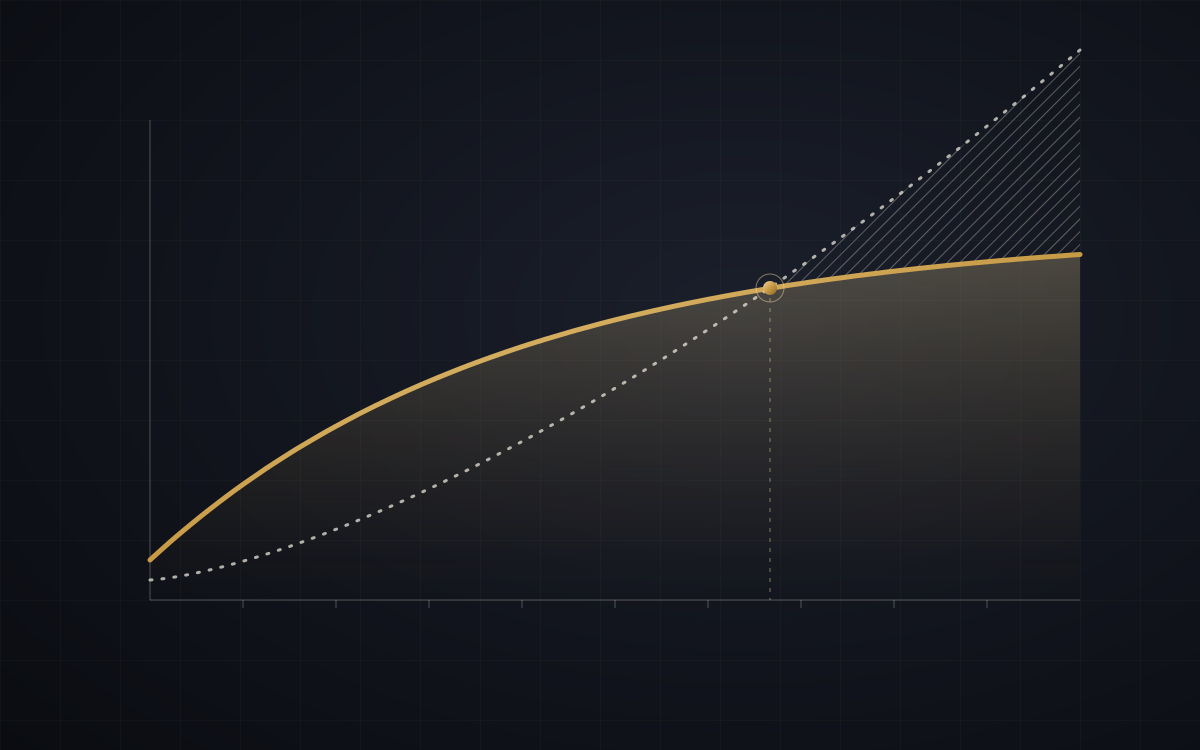
A bonus is a price cut. Whether it grows the business depends on three numbers, and most promotion reviews look at only one of them.
Start with the arithmetic of the terms. Say a player gets a bonus B with a wagering requirement of W times the bonus. The player must stake B x W before withdrawing. If the game has a house edge e, the expected theoretical loss from that play is B x W x e. The bonus pays for itself on average when that figure is higher than B. Cancel B and the test is W x e greater than 1.
At a 4% edge, W has to be above 25. At a 1% edge, W has to be above 100.
That second line is where bonuses go wrong. Wagering terms are set once, usually for slots, and then applied to a catalogue that includes games with a much lower edge. A player who finds the low-edge game and plays only that one is cheap to serve for a month and expensive for the P&L. Game weighting is the control that closes this gap. Review it every time the catalogue changes, because new content arrives with its own edge and nobody revisits the table.
This is a simple model. It ignores variance, player skill and the fact that many players never finish the requirement. It still gives you a first test that takes five minutes and catches the worst terms before they go live.
The second number is the cohort, not the campaign. A welcome offer that brings in 10,000 players looks like growth. Look at those players 90 days later. How many deposited again without an offer? How many are still active? Compare them with a cohort that joined without the offer, or with a smaller one. If the cohorts converge on the same retention, the offer bought you nothing except the first deposit, and you paid for it with margin.
The type of offer changes the maths. A welcome offer buys a first deposit and is judged on retention afterwards. A reload offer rewards existing behaviour and is usually the most exposed to subsidy, since it goes to players who already deposit. A VIP offer is personal and small in number, so it can be priced individually, and it should be, with a named owner who knows the player's history. Putting all three through the same approval and reporting process hides these differences.
The third number is the share of bonus spend that went to players who should not have received it. That includes multi-accounting, bonus hunting teams and affiliates whose traffic is built to claim offers. It also includes players who show signs of harm. In some regulated markets, operators have to stop marketing and bonuses for those customers. Where that applies, spend on them is both a commercial loss and a regulatory exposure.
Run any promotion through three checks before it goes live:
- Does the wagering requirement exceed 1 divided by the house edge of the games it can be played on?
- Does the cohort that took the offer retain better than a comparable cohort that did not, after 90 days?
- Is there a rule that stops the offer reaching flagged, duplicate or restricted accounts?
If the answer to any of these is no or unknown, the offer is a subsidy until proven otherwise.
Cost as a percentage of GGR is the usual headline figure, and it misleads in both directions. A low percentage can hide a huge cost on a small group. A high percentage during a launch can be correct. Net revenue after bonus, by cohort, tells you more. So does the ratio of bonus-only players to the base. When that ratio rises, the offer schedule is training your players.
On the commercial side, time-box offers and give each one a stated purpose. An offer meant to win back a lapsed segment should end when the segment is worked. An offer meant to support a new game launch should end after the launch window. Offers with no end date become part of the price list, and the price list gets very expensive.
Abuse needs its own owner. Fraud, payments and CRM each see part of the pattern and none of them sees all of it. Shared device fingerprints, linked payment instruments and identical play patterns usually sit in three different tools. Someone has to bring them together weekly, and decide when to void winnings and close accounts under the terms you published.
Four questions for the team:
- What are the three most expensive offers of the last quarter, by net cost after play?
- Which games count at full weight, and when did we last check their edge?
- What did the 90-day cohort comparison show for our last welcome offer?
- How many accounts did we close for bonus abuse, and what did we void?
This article is general information for operators and is not legal advice. Regulatory requirements differ by market and change, so confirm current rules with your compliance team and counsel.